
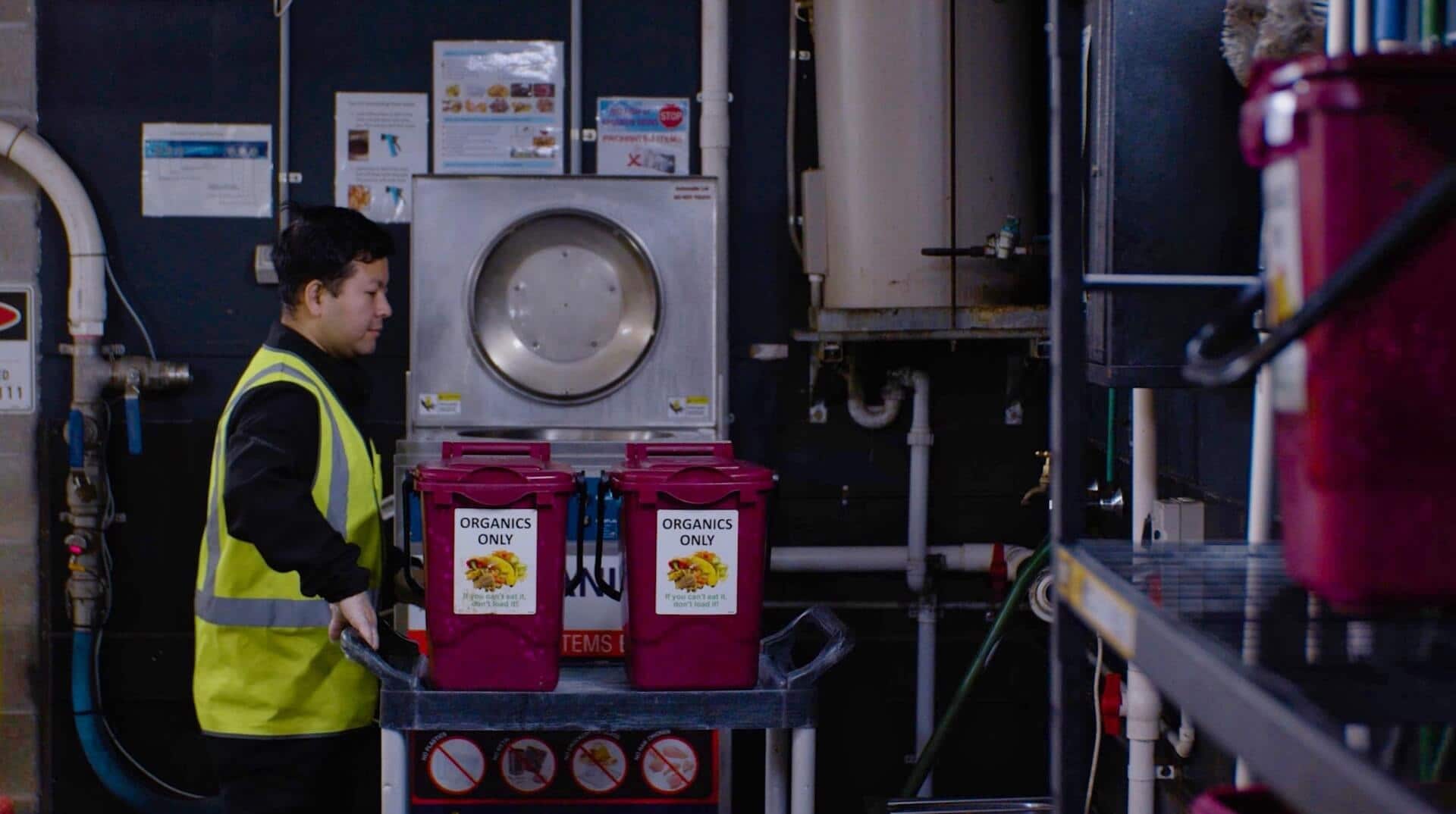
Who benefits
Virtually any business with a commercial kitchen
Accommodation, small and medium food businesses, large franchise fast food chains, hospitals, nursing homes, clubs and hotels, restaurants, cafés and supermarkets. For businesses with a smaller waste stream we recommend our mobile organics bin service.
Savings in the kitchen
- Improved efficiency handling food waste in the kitchen
- Enhanced OH&S: less carrying of waste to outside dumpster bins
- No need to carry oil waste outside, reducing slip and strain hazards
- Less liquid leakage from plastic bin liners and less back strain
- Space saved with fewer waste bins in the kitchen
- Fewer insects and rodents at the bin storage area
Savings on the bottom line
- Cheaper than weight-charged general waste removal
- Reduced spend on plastic bin liners
- Labour efficiencies: less staff time spent on waste
- Less contamination of recyclables such as cardboard and glass
- Less oil and grease entering the sewer system
- Stainless steel unit that is easy to clean and vermin proof
Frequently asked questions
Questions kitchens ask us
What food waste can go into the Pulpmaster?
Most liquid and solid food waste, including organic liquids such as cooking oil, gravy, milk, soup and juices. Liquids must not exceed 50°C, as heat affects the decay process that produces high-quality fertiliser.
What cannot go in?
Oyster and mussel shells, corn husks, lemon grass and pineapple tops. Shells grind into sand that blocks pipes over time; fibrous husks and tops form hairball-like masses that can lodge and block the machine.
Can paper go into the machine?
The Pulpmaster is for food waste. Small quantities of organic paper such as soft hand napkins can be processed.
What happens if cutlery falls in?
Cutlery can jam the machine and the LCD screen will show an error. If it is not easily seen and removed from the drum, contact our Service Team.
What about bones?
Small bones are processed and are a good source of minerals in the end product. Keep bone sizes small, and always load softer waste into the drum below and above them. Large or heavy bones should not be put in, and large quantities of bone in one session are noisy and slow.
Can wooden chopsticks or paddle-pop sticks go in?
It is not recommended to process these items on purpose.
What happens when the tank is full?
The LCD display shows the tank level as a percentage. Check the level as part of your daily routine and contact us when it is getting close, so a pump-out can be scheduled. At 100% the machine stops and displays "Tank Full".
Is user training provided?
Yes. Initial training is provided for operators and facilities staff, along with written operating instructions and laminated wall guides listing the solid and liquid foods that can be processed.
How much can it process in a single cycle?
About 70 litres in roughly 30 seconds. Electronic load sensing stops the cycle as soon as the last of the waste is processed, and the Automatic Cycle option opens the door when it finishes.
How much water does it use?
A fine water mist system uses a low volume per cycle, with variable water settings that our service technicians adjust to your requirements.
Is the system expensive or time consuming?
Pulpmaster is designed to be cost-effective and time saving. Food is heavy, and general waste is charged by weight, so removing it from the skip cuts pick-up costs. There are no bin liners to buy, staff spend less time on waste, and the stainless steel unit with self-cleaning cycle needs little maintenance.